China’s Maritime Ambitions: Beijing Drives High-Tech Expansion in Global Ports
Beijing is leveraging AI and automation to dominate global shipping infrastructure, raising concerns about strategic dependencies and security risks.
 🌍World
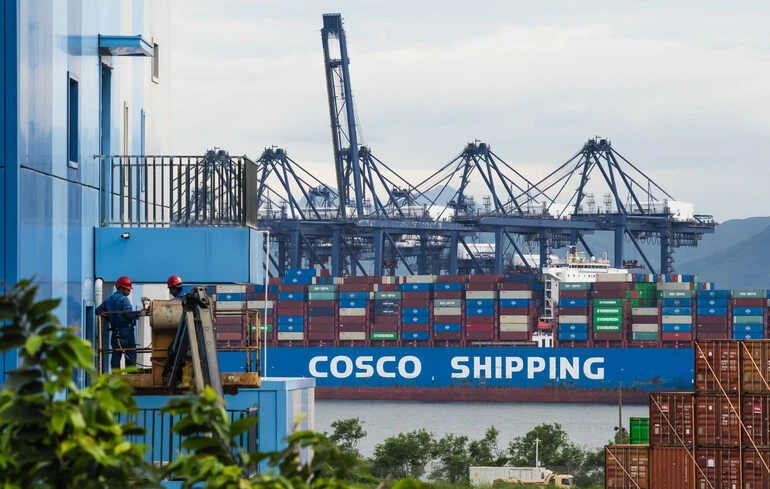
Photo: Дзеркало тижня
Key points
- China aims to operate 90 automated port terminals by 2030, significantly outpacing Western competitors.
- Chinese firms are successfully replacing US-made terminal operating software in international ports.
- Experts warn that dependency on Chinese maritime tech could lead to vulnerabilities in global trade security.
Ahead of the Asia-Pacific Economic Cooperation (APEC) summit in Shenzhen, China has showcased its vision for the future of global trade. The Mawan terminal, featuring autonomous trucks, remote-controlled cranes, and AI-driven systems, serves as a model for dozens of automated port complexes China is building to gain an edge in the industry that handles over 80% of global trade.
Automation Leadership and Global Footprint
China currently operates 60 automated terminals, more than any other nation, with plans to reach 90 by 2030. While automation in the United States has been slowed by labor union resistance, China’s rapid deployment has allowed its companies, such as Huawei and Westwell, to test and export these technologies. Westwell’s autonomous trucks are already operational in the UK’s busiest container port, Felixstowe.
Strategic Concerns and Security Risks
Western officials and analysts are increasingly wary of China’s push to export its maritime technology. Isaac Kardon of the Institute for Defense Analyses warned:
“This is a very uncomfortable dependency that could have major strategic downsides.”Potential risks range from economic coercion through technological monopolies to espionage and the ability to paralyze trade networks during a crisis.
The Battle for Digital Standards
Beyond physical infrastructure, Beijing is challenging the dominance of Western terminal operating systems (TOS). China Merchants Port has successfully implemented its proprietary software in ports across Brazil, Greece, Italy, and Turkey. This shift toward Chinese digital standards aims to eliminate reliance on foreign software and provides Beijing with unprecedented visibility into global supply chains.
Source Дзеркало тижня — zn.ua/ukr/ECONOMICS/kitaj-prahne-stati-svitovim-liderom-u-sferi-novitni… ↗
Read next
 🛡️War & Security
Russian command threatens officers with assault duty due to falsified frontline reports
Due to discrepancies between the actual situation on the Zaporizhzhia front and reports submitted to senior leadership, Russian officers are facing threats of being sent …
 ⚖️Law & Anti-corruption
Estonian Supreme Court bans smartphone voting for elections
The Estonian Supreme Court has blocked plans to introduce mobile voting apps, citing cybersecurity risks and the lack of state control over private app stores.
 🇺🇦Ukraine
Ukrainian defense industry produces over half of artillery shells for the front
Rheinmetall CEO Armin Papperger stated that Ukrainian facilities now manufacture more than 50% of the artillery ammunition used by the Defense Forces.
 🇺🇦Ukraine
Russian army attacks Kremenchuk with drones: casualties include children
On the evening of November 27, Russian forces launched a drone strike on Kremenchuk in the Poltava region. Four civilians were injured, including three children.
 ⚖️Law & Anti-corruption
NABU Director Semen Kryvonos responds to criticism over skipping parliamentary commission hearings
Semen Kryvonos explained his absence from the Verkhovna Rada's temporary investigative commission hearings by citing foreign business trips and alleged pressure on anti-c…
 🇪🇺Europe & EU
Remains of Polish Army soldiers killed in 1939 reburied in Lviv region
A ceremony was held in the Lviv region to rebury 115 Polish Army soldiers who died during the 1939 defense of Lviv.