Disinformation in Africa: Democratic threat or a tool for state control?
Experts warn that misinformation and AI-driven manipulation in Africa are increasingly used by governments not just to combat falsehoods, but to silence political dissent and restrict free speech.
 🌍World
Photo: DW (EN)
Key points
- AI and social media have intensified the spread of political disinformation during African elections.
- Certain governments exploit anti-disinformation measures to censor independent media and silence critics.
- Grassroots media literacy initiatives face significant funding challenges and state resistance.
The proliferation of misleading content across messaging apps and social media platforms poses a critical challenge to political stability in African nations, particularly during electoral periods. As artificial intelligence makes the fabrication of images, audio, and video increasingly accessible, ordinary citizens face growing difficulties in verifying facts, leaving them vulnerable to deliberate manipulation.
According to Dani Madrid-Morales, a journalism researcher at the University of Sheffield, numerous governments leverage the rhetoric surrounding disinformation to serve their own political agendas. In the Sahel region, for instance, military-led authorities in Burkina Faso and Mali have systematically shut down independent media outlets, prosecuted journalists, and expelled foreign correspondents under the guise of national security.
"Governments are particularly interested in the third category [political disinformation originating from within]," Madrid-Morales notes, pointing to efforts aimed at suppressing negative narratives about ruling regimes.
At the same time, civil society organizations across the continent are spearheading media literacy initiatives to educate the public. Organizations such as Africa Check in South Africa and Penplusbytes in Ghana conduct workshops and outreach programs to help citizens identify manipulated sources. However, these grassroots efforts frequently struggle with chronic funding shortages and resistance from state actors seeking to maintain a tight grip on information flows.
Source DW (EN) — dw.com/en/fake-news-in-africa-in-an-age-of-disinformation-who-decid… ↗
Read next
 🛡️War & Security
Russian command threatens officers with assault duty due to falsified frontline reports
Due to discrepancies between the actual situation on the Zaporizhzhia front and reports submitted to senior leadership, Russian officers are facing threats of being sent …
 ⚖️Law & Anti-corruption
Estonian Supreme Court bans smartphone voting for elections
The Estonian Supreme Court has blocked plans to introduce mobile voting apps, citing cybersecurity risks and the lack of state control over private app stores.
 🇺🇦Ukraine
Ukrainian defense industry produces over half of artillery shells for the front
Rheinmetall CEO Armin Papperger stated that Ukrainian facilities now manufacture more than 50% of the artillery ammunition used by the Defense Forces.
 🇺🇦Ukraine
Russian army attacks Kremenchuk with drones: casualties include children
On the evening of November 27, Russian forces launched a drone strike on Kremenchuk in the Poltava region. Four civilians were injured, including three children.
 ⚖️Law & Anti-corruption
NABU Director Semen Kryvonos responds to criticism over skipping parliamentary commission hearings
Semen Kryvonos explained his absence from the Verkhovna Rada's temporary investigative commission hearings by citing foreign business trips and alleged pressure on anti-c…
 🇪🇺Europe & EU
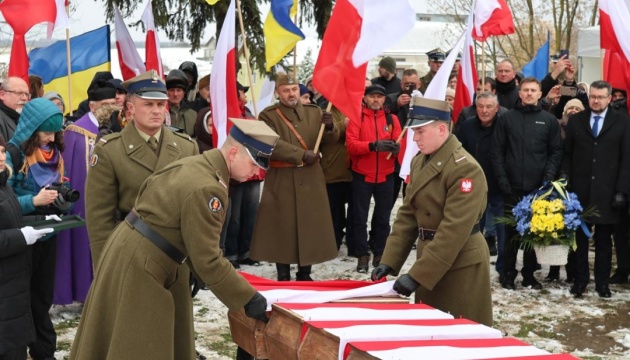
Remains of Polish Army soldiers killed in 1939 reburied in Lviv region
A ceremony was held in the Lviv region to rebury 115 Polish Army soldiers who died during the 1939 defense of Lviv.